
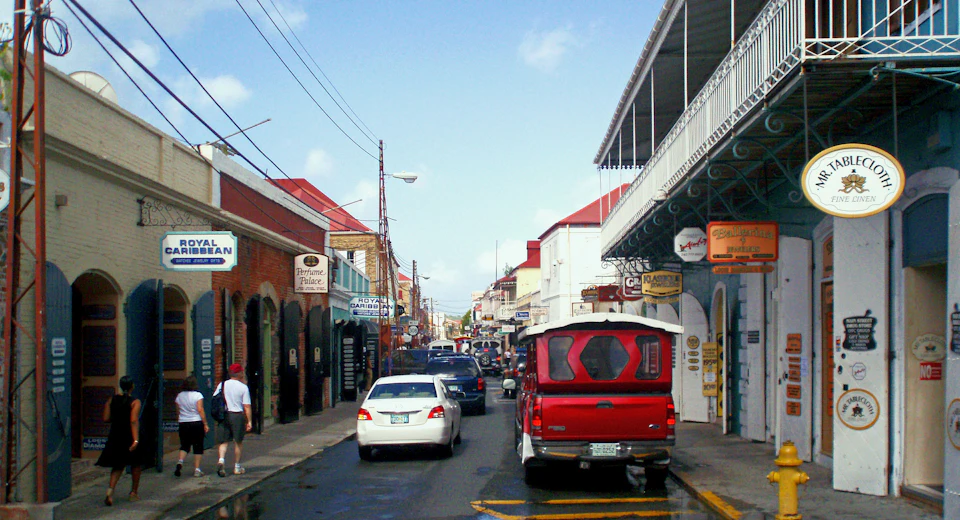
Duval really does cross the island
Duval Street runs from the Gulf-side waterfront to the Atlantic, covering roughly 1.25 miles.
The City describes it as a corridor stretching from one side of Key West to the other.
That relatively short distance is one reason visitors make the mistake of treating Duval as one homogeneous strip.
It isn't.
For visitor planning, it helps to think of Duval in three loose sections.
These are editorial zones, not official neighborhood boundaries.
Lower Duval: waterfront, crowds and classic first-visit Key West
At the northwestern end, Duval meets the waterfront close to Mallory Square.
This is where first-time visitors find some of the most recognizable Key West energy: historic buildings, bars, shops, heavy pedestrian activity and easy access to the waterfront.
The Historic Seaport is also only a short walk away. The City specifically notes the proximity between the Bight marina, Duval and Mallory Square.
BEST FOR
- first-time orientation,
- nightlife,
- quick access to Mallory Square,
- waterfront wandering,
- and visitors who want the most active part of the street.
GOOD TO KNOW
This is also where it is easiest to conclude that all of Key West looks like Duval.
It doesn't.
Walk a few blocks away before making that judgment.
Middle Duval: the useful transition
As you move farther south, the street continues mixing:
- bars,
- restaurants,
- galleries,
- shops,
- historic structures,
- and side streets leading deeper into Old Town.
This is where Duval works best as a spine.
Instead of walking 14 blocks straight in one direction, turn onto streets such as Caroline, Eaton, Fleming, Southard or Petronia and see what happens to the city after one or two blocks.
St. Paul's Episcopal Church at 401 Duval, for example, occupies a site whose parish history stretches to the early 1830s.
The Oldest House Museum at 322 Duval provides another reminder that the street's history predates its modern nightlife reputation.
Upper Duval: quieter and easier to slow down
Toward Truman Avenue and the Atlantic end, Duval's character changes again.
There are still restaurants, shops and visitor businesses, but the street begins feeling less like a continuous nightlife corridor.
Near the southern end you'll also find the Key West Butterfly & Nature Conservatory at 1316 Duval and eventually South Beach at the Atlantic end.
BEST FOR
A slower walk, couples, shopping and visitors exploring southern Old Town.
GOOD TO KNOW
If you only see the first few blocks by Mallory Square and declare that you have “done Duval,” you have really only experienced one version of it.
Daytime Duval and nighttime Duval are different places
During the day, Duval functions as a pedestrian sightseeing and shopping corridor.
Later, bars, music and nightlife become more dominant in parts of the street.
Neither version is more authentic.
They simply serve different visitors.
With children
There is no reason families need to avoid Duval altogether.
Walk during the day, visit attractions, eat and move on when the atmosphere no longer fits the family.
If nightlife is the point
Stay reasonably central and avoid creating a nightly transportation problem by booking accommodation far away simply to save a little on the room.
That is one of the cases where location changes the quality of the trip.
Do you need to walk the entire thing?
No.
You can.
At roughly 1.25 miles end-to-end, it is completely manageable for many visitors.
But completing Duval as if it were a hiking trail misses the point.
A better approach is to use it to connect:
- Mallory Square,
- the side streets of Old Town,
- Bahama Village,
- museums,
- the Historic Seaport,
- and southern Old Town.
The best Duval strategy for a first visit
Start near one end and walk several blocks.
When you see a side street that looks interesting, take it.
Return later.
Spend a different evening around the Historic Seaport.
Walk Whitehead Street.
Explore residential Old Town.
Key West becomes more interesting as soon as Duval stops being the only line on your mental map.
Is Duval just touristy?
Yes, parts of it are heavily visitor-oriented.
That does not make the street irrelevant.
Duval has genuinely historic structures, long-established businesses, galleries, nightlife and cultural landmarks mixed into modern tourism.
The mistake is not going to Duval.
The mistake is expecting Duval to explain the entire island.
Is driving Duval useful?
Usually not.
If you are already staying within the historic core, walking is the better way to experience the street.
The City is also actively planning long-term Duval resiliency and revitalization work, and public works projects can periodically affect individual blocks.
A good two-hour Duval introduction
Do not treat this as a timed itinerary.
Use it as a pattern:
Start near the waterfront.
Walk part of lower Duval.
Take one side street.
See a historic building or museum.
Continue south.
Stop when something interests you.
By the time you reach the quieter end, decide whether you actually want to complete the street or whether another part of Old Town is calling.
That is much more Key West than marching from block zero to block fourteen because a guide told you to.